
The Department of State (“DOS”) Visa Office has released the June 2026 Visa Bulletin. The EB-1 and EB-2 categories for India will retrogress next month. The cut-off date for EB-1 India will move back by 3.5 months, while EB-2 India will significantly retrogress by more than 10 months. EB-3 China and India will have modest advancement while the cut-off dates for the remaining preference categories for China, Rest of World, Mexico, and the Philippines will remain stalled.
The DOS in the Visa Bulletin warns that further retrogressions may be necessary for EB-1 and EB-2 India due to the high demand for visa numbers. If India’s pro-rated limits in the EB-1 or EB-2 categories are reached before the fiscal year (FY) ends on September 30, 2026, these categories will be made unavailable. Furthermore, steady demand for EB-2 China and EB-3 Philippines may make it necessary to retrogress the Final Action Dates in the coming months to hold number use within the maximum allowed under the FY 2026 annual limit.
The U.S. Citizenship and Immigration Services (“USCIS”) has confirmed that the Final Action Dates chart for Employment-Based Visas must be used for the month of June.
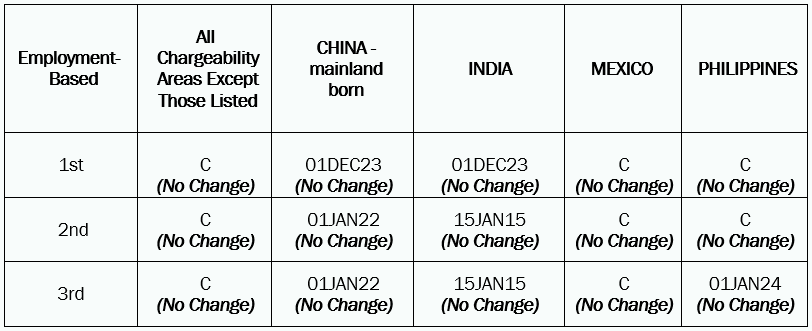
Application Filing Dates (when an immigrant visa or adjustment of status application can be filed). Foreign nationals with priority dates earlier than the dates for filing visa applications indicated in the Visa Bulletin chart below, or where noted as “C” for “current,” may file an immigrant visa application through the Department of State consular service (“consular processing”) during the applicable month. Such persons may also apply for adjustment of status (“I-485 application”) through USCIS in the United States, provided that USCIS has indicated on its website that the cut-off dates indicated on the Application Filing Date chart may be used for adjustment filings during the applicable month. If USCIS does not indicate that the Application Filing Date chart may be used for adjustment filings, the adjustment application must be filed based on the Final Action Date chart (see below).
Application Final Action Dates (when an immigrant visa or adjustment of status application can be approved). Foreign nationals with priority dates earlier than the final action dates indicated in the Visa Bulletin chart below, or where noted as “C” for “current,” may be approved for an adjustment of status application (I-485) or immigrant visa during the applicable month. The Final Action Dates Chart also determines when an adjustment of status application may be filed, unless USCIS indicates that the earlier Application Filing cut-off dates may be used to determine when the adjustment may be filed for that particular month.
Application Final Action Dates for June 2026*:
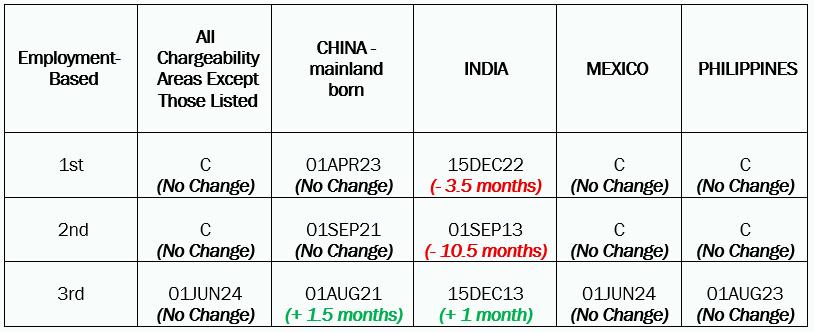
*We have omitted the information for El Salvador, Guatemala, and Honduras, as well as the 3rd "Other Workers," 4th, and 5th Preference Categories from these charts. To view the full bulletin, please visit the Department of State Visa Bulletin page.
Dates for Filing Visa Applications for June 2026*:
How Immigrant Visa Quotas and the Visa Bulletin Work
The Immigration and Nationality Act limits the number of employment-based immigrant visas that may be issued each year to a worldwide level of 140,000. The Act also allocates this limited number of visas based on preference category and country of birth, such that each country is subject to an individual per-country quota, in addition to the overall worldwide quota. For foreign nationals who are being sponsored by their employers for a green card, the most common preference categories are: the employment-based first preference category (EB-1), which is reserved for aliens of extraordinary ability, outstanding researchers, and multinational managers; the employment-based second preference category (EB-2), which is reserved for advanced degree holders [1] and aliens of exceptional ability; and the employment-based third preference category (EB-3) which is designated for professionals, skilled workers and “other” workers.
Due to the limited number of immigrant visas, combined with the very high demand for these visas, most foreign nationals are subject to significant backlogs that delay the process of obtaining permanent residency. These backlogs are expressed as “final action cut-off dates” in the Department of State’s monthly Visa Bulletin. The foreign national’s place in line for purposes of the quota backlogs is referred to as the “priority date.” In the employment-based context, the priority date is established on the date that the employer starts the green card process by filing a PERM labor certification application or immigrant petition on the foreign national’s behalf. Before the foreign national can be approved for a green card, the sponsored foreign national’s priority date must fall on a date that is earlier in time than the applicable final action cut-off date listed in the Bulletin.
As of October 2015, each month’s Visa Bulletin also includes a separate chart providing “filing cut-off dates,” which indicate when the last step of the permanent residency process may be filed. This two-tier Visa Bulletin, with separate cut-off dates for approval and final action, is designed to help the Department of State more accurately predict demand of green cards, and better regulate the number of green cards approved each year. It is believed that the two-tier Visa Bulletin system will reduce fluctuation in cut-off dates in the Bulletin each month, and reduce the number of "lost" immigrant visa numbers each year.
Note that where a preference category is not affected by a quota backlog for a particular country of birth, the cut-off date is indicated as “current” (“C”) in the Visa Bulletin. This means that the foreign national may apply for the final step of the green card process irrespective of his/her priority date.
[1] The EB-2 category is reserved for foreign nationals who possess either an advanced degree (master’s or higher), or equivalent, or qualify as an “Alien of Exceptional Ability.” The equivalent of an advanced degree is defined as a bachelor’s degree followed by five years of progressively responsible experience in the field. Note that where a bachelor’s degree and five years of experience are used to qualify for EB-2, the bachelor’s degree must normally be a 4-year “single source” degree, and must also be deemed equivalent to a U.S. bachelor’s degree. Also note that to qualify for EB-2 as an advanced degree holder, the position for which the foreign national is being sponsored must actually require an advanced degree or equivalent.