
On March 27, 2026, the U.S. Department of Labor’s (DOL) Employment and Training Administration published a proposed rule, “Improving Wage Protections for the Temporary and Permanent Employment of Certain Foreign Nationals in the United States,” to revise the methodology used for determining prevailing wage requirements for H-1B, H-1B1, and E-3 temporary workers, and permanent labor certification applications (PERM), which is required for most employer-sponsored green card processes. If finalized, the rule may require employers to pay higher wages for some of its foreign workers who are sponsored under these programs. However, employers would still have the option of submitting private wage surveys as an alternative to the DOL prevailing wage figures affected by the rule change.
Background
The current prevailing wage methodology, promulgated in 2005, has been criticized by the Trump Administration for failing to protect U.S. workers. The Administration contends that the methodology enables employers to hire and retain foreign workers at lower wages than what are paid to similarly employed U.S. workers.
This proposed rule resuscitates the 2020 Interim Final Rule (IFR) introduced by the first Trump Administration that increased the prevailing wage requirements for employing foreign workers. The IFR was later enjoined by the courts on procedural grounds, and a subsequent attempt by the first Trump Administration to increase prevailing wage levels was withdrawn by the Biden Administration in early 2021.
Proposed Changes
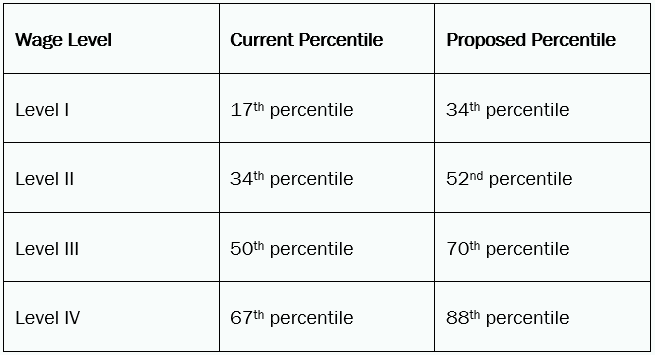
Similar to the 2020 IFR, the DOL proposes to adjust the wage percentiles used in the four-tier prevailing wage structure (Level I, II, III, and IV). The stated purpose of the proposed rule is to recalibrate wage level requirements for the H-1B, H-1B1, E-3, and PERM programs to better protect the wages and working conditions of U.S. workers.
Under the proposed rule, the Level I wage would be increased from the 17th percentile to the 34th percentile and the Level IV wage would be increased from the 67th percentile to the 88th percentile based on wage data for the most specific occupation and geographic area available. By statute, Level II and Level III are set arithmetically between Level I and Level IV. This change in methodology would increase leveling across the board.
The public comment period on the Proposed Rule will close on May 26, 2026. Hundreds of comments have already been submitted.
If the rule becomes final, it would apply to Prevailing Wage Determination (PWD) Requests (required for PERM applications) and Labor Condition Applications (required for H-1B, H-1B1, and E-3 petitions and applications), that are filed on or after the rule’s effective date. It is expected that the effective date would be set soon after the final rule’s publication in the Federal Register, which could be as soon as June of this year.
What This Means for Our Clients
If finalized, the proposed rule will introduce new challenges for employers that could affect the cost, feasibility, and timing of sponsoring foreign workers under the H-1B, H-1B1, E-3, and PERM programs, particularly for entry-level and early-career employees. However, employers may continue to utilize private wage surveys that meet the DOL requirements as an alternative. These surveys often provide a viable alternative to the DOL figures.
We also expect that the rule, if finalized, will be met with significant legal challenges. The questionable data and analysis used to justify the proposed changes may provide a viable basis for successful litigation.
We will work with each of our clients individually to help find the best solution to ensure the ongoing success of their immigration program amid the proposed changes. This may involve reviewing private wage surveys for suitable alternatives to the DOL’s figures, and filing labor condition applications for H-1B workers in advance of the expected effective date of the proposed rule.
We will provide more information as it becomes available.
This alert is provided for informational purposes only and does not constitute legal advice. Please contact our office for guidance specific to your situation.