
The Department of State (“DOS”) Visa Office has released the December 2026 Visa Bulletin. The December 2026 Visa Bulletin brings no movement in the employment-based Final Action Dates or Dates for Filing for the EB-1, EB-2, and EB-3 categories listed below, which remain unchanged from November for all countries. The December bulletin also includes a new statement from DOS noting that dates have been advanced in recent months because immigrant visa issuance has decreased, and that retrogression may be necessary in upcoming months to keep issuance within annual limits. DOS further notes that visa categories may become “unavailable” before the end of the fiscal year if annual, category, or per-country limits are reached.
U.S. Citizenship and Immigration Services (“USCIS”) has confirmed that the Dates for Filing chart for Employment-Based Visas must be used for the month of December.
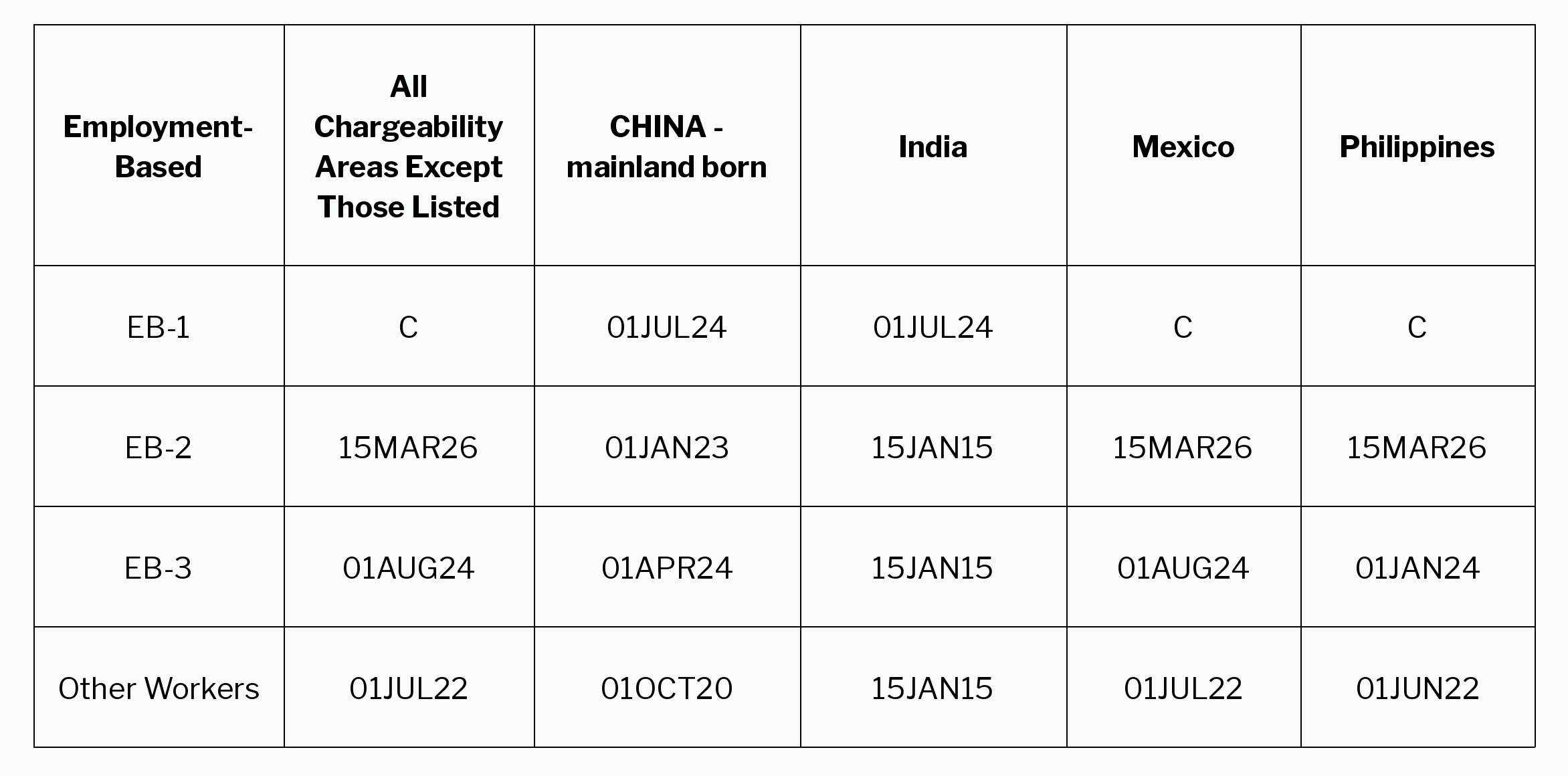
Dates for Filing (when an immigrant visa or adjustment of status application may be filed). Foreign nationals whose priority dates are earlier than the date listed in the Dates for Filing chart below, or whose category is listed as “C” (“current”), may submit their immigrant visa documents to the Department of State’s National Visa Center for processing at a U.S. consulate abroad (“consular processing”) during the applicable month. They may also file an application for adjustment of status (“I-485 application”) with USCIS in the United States, provided that USCIS has announced on its website that the Dates for Filing chart may be used for adjustment of status filings that month. If USCIS does not make that announcement, adjustment of status applications must be filed based on the Final Action Dates chart.
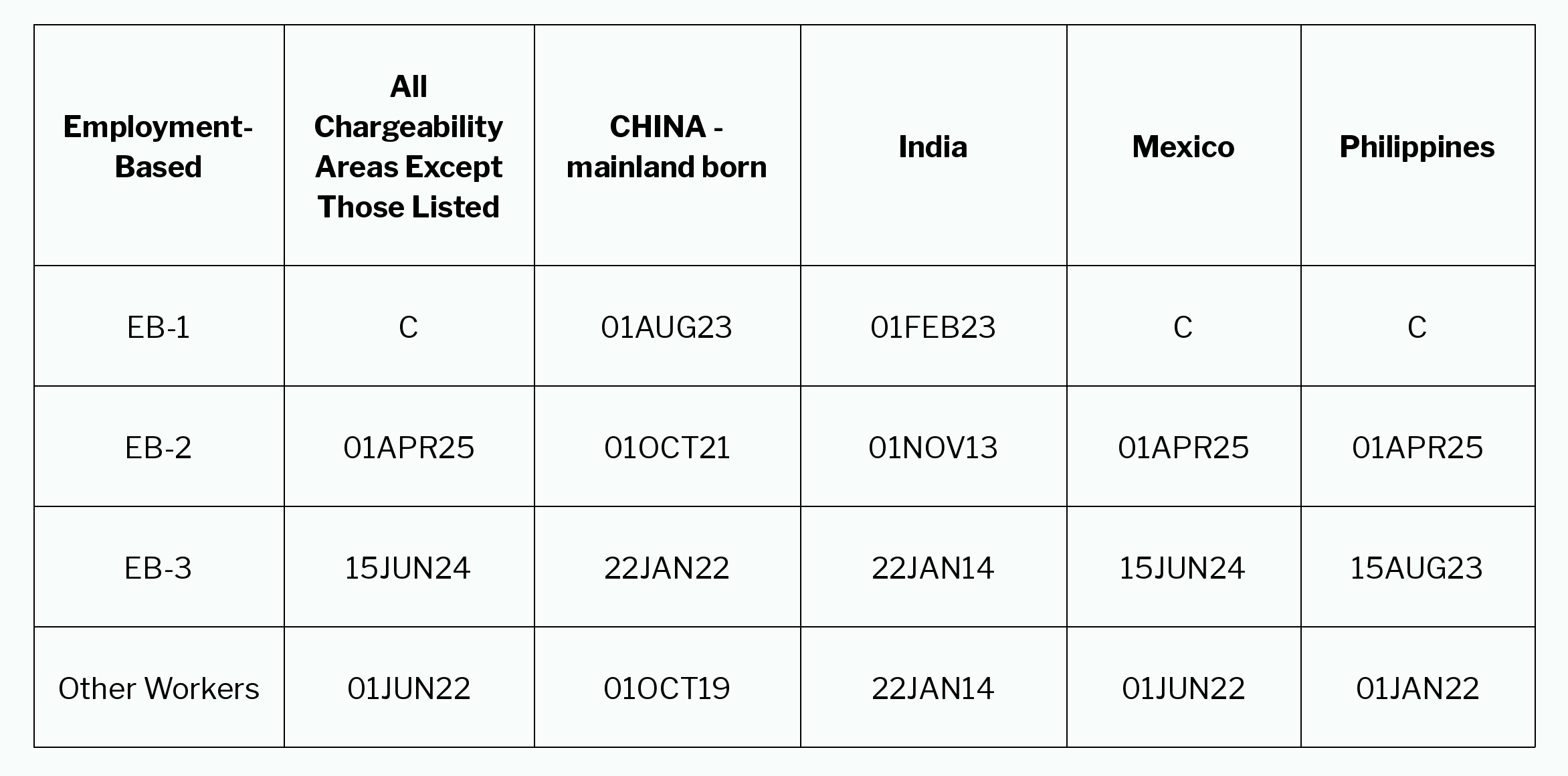
Final Action Dates (when an immigrant visa or adjustment of status application may be approved). Foreign nationals whose priority dates are earlier than the date listed in the Final Action Dates chart below, or whose category is listed as “C” (“current”), may be issued an immigrant visa or approved for adjustment of status during the applicable month. The Final Action Dates chart also governs when an adjustment of status application may be filed, unless USCIS announces that the more advanced Dates for Filing chart may be used that month.
Application Final Action Dates for December 2026:
Dates for Filing for December 2026:
How Immigrant Visa Quotas and the Visa Bulletin Work
The Immigration and Nationality Act limits the number of employment-based immigrant visas available each fiscal year to a worldwide level of at least 140,000. Visas are allocated by preference category and by country of birth, and each country is subject to a per-country limit in addition to the worldwide limit. For foreign nationals sponsored by their employers, the most common preference categories are the employment-based first preference (EB-1), for individuals of extraordinary ability, outstanding professors and researchers, and multinational executives and managers; the employment-based second preference (EB-2), for members of the professions holding advanced degrees [1] and individuals of exceptional ability; and the employment-based third preference (EB-3), for professionals, skilled workers, and other workers.
Because demand for these visas exceeds the number available, many foreign nationals face backlogs that delay permanent residence. A foreign national’s place in line is determined by the “priority date,” which in most employment-based cases is the date the employer filed the PERM labor certification application with the Department of Labor or, where no labor certification is required, the date the Form I-140 immigrant petition was filed with USCIS. These backlogs are reflected in the cut-off dates published in the Department of State’s monthly Visa Bulletin. A green card may be approved only when the foreign national’s priority date is earlier than the applicable Final Action Date.
Since October 2015, each Visa Bulletin has included two charts: the Final Action Dates chart, which governs when a case may be approved, and the Dates for Filing chart, which indicates when applicants may begin the final step of the process. The two-chart system is intended to help the Department of State and USCIS anticipate demand and manage the use of available visa numbers over the fiscal year.
Where a category is not backlogged for a particular country of birth, the Visa Bulletin lists it as “C” (“current”), and the foreign national may proceed with the final step of the green card process regardless of priority date.
[1] An advanced degree is a U.S. master’s degree or higher, or a foreign equivalent degree. A U.S. bachelor’s degree, or a foreign equivalent degree, followed by at least five years of progressive post-baccalaureate experience in the specialty is treated as the equivalent of a master’s degree. The bachelor’s degree must generally be a single degree that is equivalent to a U.S. bachelor’s degree; a combination of lesser degrees, or of education and experience, generally will not qualify. In addition, the position for which the foreign national is sponsored must itself require an advanced degree or its equivalent.